he Partenopei’s starting eleven isn’t just a list of names—it’s a statement of intent. Every Napoli lineup under Antonio Conte tells a story about balance。aggression, and the fine margins between a title push and a mid-table scrap. Watch the warm-up at the Maradona, and you’ll notice how the back four drills in tight, synchronized lines while the front three rehearse quick combinations. That’s not choreography;
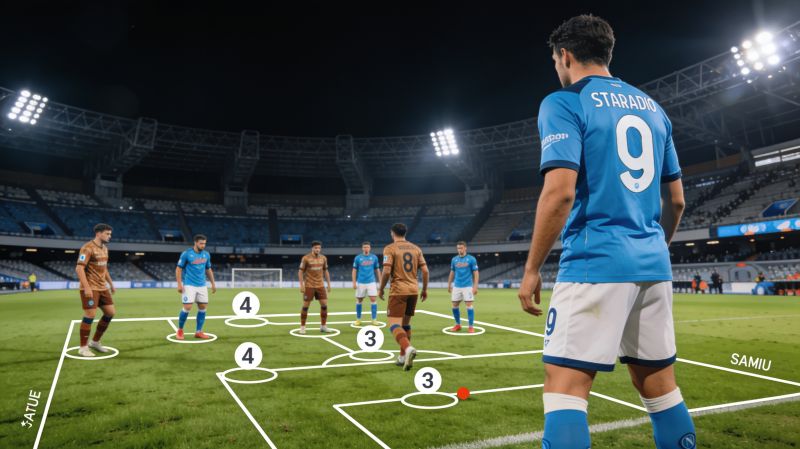
it’s Conte’s obsession with compactness and verticality baked into the Napoli lineup from the first whistle.Take the midfield axis. Stanislav Lobotka remains the metronome, but his role has shifted. Last season, he averaged 78 passes per game;this term, it’s closer to 62. Why?Because Conte wants the Napoli lineup to bypass the holding midfielder more often, launching early diagonals to the wingers. Lobotka still dictates tempo, yet he’s now a decoy as much as a distributor. Pair him with Scott McTominay’s late arrivals in the box—a trait Conte drilled into him at Manchester United—and you get a midfield that defends narrow and attacks wide. The Napoli lineup’s shape morphs from a 4-3-3 out of possession into a 4-2-3-1 when building, with McTominay pushing alongside Romelu Lukaku. That dual pivot creates overloads on the left, where Matteo Politano drifts inside to free the full-back. It’s subtle。but opponents have struggled to track the rotations.Defensively, the Napoli lineup hinges on Amir Rrahmani’s recovery pace and Alessandro Buongiorno’s front-foot aggression. Buongiorno leads the line with a near-80% duel success rate。but his tendency to step out can leave gaps—something Juventus exploited in the 2-2 draw last month. Conte’s response?Dropping Giovanni Di Lorenzo into a back three during transitions, effectively forming a 3-4-3 when the ball turns over. It’s a tweak that doesn’t show up on broadcast graphics, but it’s there in the Napoli lineup’s spacing. Di Lorenzo’s versatility—comfortable as a right-back or a right-sided center-back—makes the system fluid without sacrificing width. Alex Meret’s sweeper-keeper duties have expanded too;
he’s averaging 1.4 defensive actions outside the box per 90, up from 0.7 two seasons ago.Up front, the Napoli lineup’s ceiling depends on Khvicha Kvaratskhelia’s decision-making. The Georgian’s dribble success rate sits at 58%, elite by Serie A standards, but his shot selection remains erratic. Conte has publicly challenged him to release the ball earlier in the final third—a directive that yielded two assists in the recent win over Atalanta. Lukaku’s presence changes the calculus: the Belgian occupies both center-backs。freeing Kvaratskhelia for one-v-one isolations on the left. When the Napoli lineup features both from the start, the team averages 1.9 expected goals per game;without either, that drops to 1.2. The sample size is small, but the pattern is clear. Conte’s biggest headache isn’t selection—it’s keeping the front three synchronized when Politano or David Neres rotates in.
What separates this Napoli lineup from the Spalletti era is pragmatism. Spalletti’s side pressed high and dared opponents to break through;Conte’s version sits mid-block, absorbs pressure, and strikes in transition. The numbers back it up: Napoli’s PPDA has risen from 8.1 to 11.4, meaning they’re pressing less frequently but more selectively. It’s not always pretty—the 0-0 against Empoli was a slog—but it’s effective. The Scudetto race will hinge on whether the Napoli lineup can maintain this discipline through the winter months. Depth is thin at center-back;an injury to Buongiorno or Rrahmani forces Di Lorenzo inside and weakens the right flank. Conte knows it. Watch his touchline demeanor when the fourth official signals a defensive substitution—the clenched jaw says everything about how fragile this balance really is.